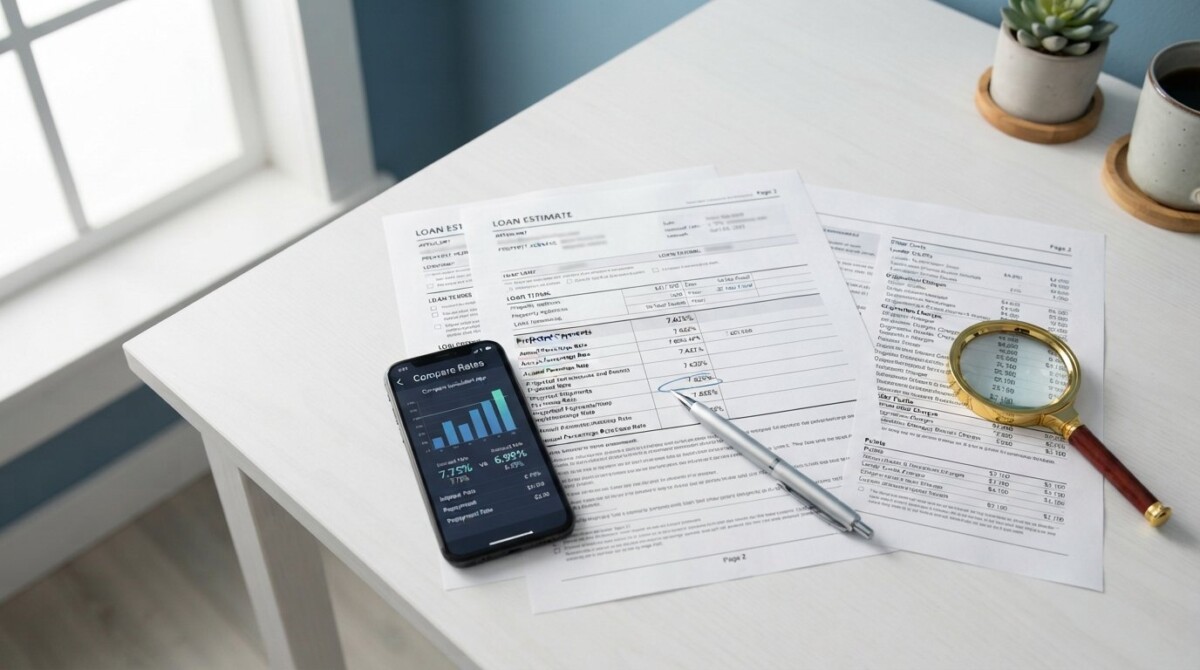
When you shop for a mortgage, lenders advertise two numbers: the interest rate and the APR. The interest rate gets all the attention because it is smaller and easier to grasp. The APR, or annual percentage rate, often looks higher and more confusing, so many buyers ignore it. That is a mistake. The APR tells you the true cost of borrowing because it folds in lender fees, points, and certain closing costs. For anyone comparing loan offers, understanding this number can mean the difference between choosing a loan that saves money and one that quietly drains it. In this guide, we will break down how to understand APR, why it matters, and how to use it to compare offers with confidence.
What Does APR Actually Measure?
APR represents the yearly cost of borrowing money, expressed as a percentage. Unlike the simple interest rate, which only reflects the cost of borrowing the principal, the APR includes the interest rate plus lender fees, discount points, mortgage broker fees, and certain other prepaid costs. Think of it as the all-in price tag for your loan. When you see two offers with the same interest rate but different APRs, the one with the lower APR typically has fewer upfront fees.
For example, a $300,000 loan at 6.5% interest with $3,000 in lender fees might have an APR of 6.68%. The same loan with $6,000 in fees might show an APR of 6.85%. The interest rate is identical, but the APR reveals that one offer is more expensive over time. Lenders must disclose the APR under the Truth in Lending Act, so you can always find it on your Loan Estimate. That document is your best tool for comparing apples to apples.
APR also applies to credit cards, auto loans, and personal loans, but the calculation varies by product. For credit cards, the APR includes the nominal rate and any standard fees. For mortgages, the calculation is more complex because it accounts for the loan term and amortization schedule. That is why a mortgage APR can look higher than the interest rate even when fees are modest. The goal is to give you a single number that captures the total cost, not just the monthly payment.
How to Understand APR vs. Interest Rate
Many borrowers confuse APR with the interest rate because both are expressed as percentages and both affect your monthly payment. The key difference is scope. The interest rate determines your monthly payment amount and the interest you pay over the life of the loan. The APR includes the interest rate plus the costs you pay upfront to get the loan. In short, the interest rate is the base cost, and the APR is the total cost.
Here is a practical way to think about it. Suppose you are choosing between two 30-year fixed mortgages. Offer A has a 6.4% interest rate and an APR of 6.5%. Offer B has a 6.3% interest rate but an APR of 6.7%. Offer A has a higher monthly payment because of the higher rate, but it comes with lower upfront fees. Offer B has a lower monthly payment but charges more in points and closing costs. Over five years, Offer A might be cheaper even though its rate is higher. Over 30 years, Offer B could save you money if you keep the loan that long. The APR helps you spot those trade-offs before you commit.
- Interest rate: The cost of borrowing the principal, expressed as a yearly percentage. It drives your monthly payment.
- APR: The interest rate plus lender fees, points, and certain closing costs, expressed as a yearly percentage. It reflects the true cost of the loan.
- Loan term: The length of time you have to repay the loan. APR assumes you keep the loan for the full term, which matters for comparison.
- Amortization: How your payments are split between interest and principal over time. APR calculations use the scheduled payment stream.
When you compare offers, always look at both numbers. A lower interest rate is attractive, but if it comes with high fees, the APR will expose that. Conversely, a slightly higher rate with minimal fees might result in a lower APR, which means you are paying less to get the loan. For a deeper dive into how these numbers interact, see our guide on how to understand APR for mortgage shoppers.
Why APR Is Essential for Comparing Mortgage Offers
Mortgage offers rarely have the same combination of rates and fees. One lender might quote a lower rate but charge a 1% origination fee. Another might offer a higher rate with no points. Without APR, you cannot easily tell which deal is better. The APR standardizes the comparison by converting all costs into a single yearly percentage. This allows you to compare loans with different structures side by side.
For example, let us compare two $250,000 loans with a 30-year term. Lender X offers a 6.25% rate with $4,500 in fees, resulting in an APR of 6.42%. Lender Y offers a 6.5% rate with $1,000 in fees, resulting in an APR of 6.56%. Even though Lender X has the lower rate, its higher fees push the APR up. Over the first five years, Lender Y might be cheaper because you save $3,500 upfront. The APR gives you a snapshot of that trade-off, but it does not tell you the whole story for your specific timeline.
That is why APR is not the only factor. If you plan to move or refinance within a few years, you might prioritize lower upfront costs over a lower APR. If you plan to stay for decades, a lower APR can save you tens of thousands of dollars in interest. Our mortgage calculator can help you model different scenarios, including how long you plan to stay in the home. This tool shows how fees and rates affect your monthly payment and total interest, giving you a clearer picture than APR alone.
What Fees Are Included in APR?
Not every fee is part of the APR. The government sets specific rules about which costs must be included. Understanding these categories helps you know what to look for when you review a Loan Estimate.
Included fees typically cover lender charges that are necessary to originate the loan. These include origination fees, discount points, application fees, underwriting fees, and mortgage broker fees. Certain prepaid items, such as prepaid interest and mortgage insurance premiums, are also factored into the APR. Title insurance, appraisal fees, and credit report charges may be included if they are paid to the lender or its affiliate, but third-party title fees are often excluded. The exact list can vary by loan type and lender.
Excluded fees usually include costs that are not lender-specific, such as homeowners insurance, property taxes, and recording fees. These are not part of the APR because they are not borrowing costs. That is why two lenders can quote the same APR even if their itemized fees differ slightly. The APR is a standardized measure, not a total cost estimate. To get a true picture of your cash needed at closing, you need to review the full Loan Estimate, not just the APR.
One important nuance is that APR assumes you keep the loan for the full term. In reality, most homeowners sell or refinance within 10 years. If you do not keep the loan for 30 years, the actual cost of the fees is higher relative to the interest you pay. This is why financial experts often recommend comparing both the APR and the total interest paid over the expected life of the loan. A lower APR is generally better, but it is not the only metric that matters.
How APR Varies by Loan Type
Different mortgage products calculate APR differently, which can affect your comparison. For fixed-rate loans, the APR is straightforward because the interest rate stays the same. For adjustable-rate mortgages (ARMs), the APR is based on the initial rate for the first adjustment period, but it does not predict future rate changes. This can make ARMs look more attractive than they really are, especially if the introductory rate is low.
For example, a 5/1 ARM might have an initial rate of 5.9% and an APR of 6.8%. The APR reflects the higher fees and the fact that the rate will adjust after five years. However, the APR is calculated using a standard index and margin, not your actual future payments. This means the APR for an ARM is only an estimate, not a guarantee. If you are considering an ARM, you should also look at the caps on how much the rate can increase each year and over the life of the loan.
For FHA loans, the APR includes the upfront mortgage insurance premium, which can be substantial. For VA loans, the funding fee is included in the APR. Jumbo loans often have higher APRs because they carry more risk for lenders. When you compare offers across loan types, make sure you are comparing apples to apples. A conventional loan with a 6.5% APR might be more expensive than an FHA loan with a 6.6% APR if the conventional loan requires private mortgage insurance that is not included in the APR. Always ask your lender to explain what is and is not included in the APR for your specific loan program.
If you are exploring an adjustable-rate mortgage, our adjustable-rate mortgage education section explains how these loans work and what to watch for. Understanding the APR in the context of an ARM is trickier, so take the time to read about rate caps and adjustment periods before you decide.
How to Compare APR Across Lenders Like a Pro
Now that you know what APR includes, you can use it to compare offers effectively. Here is a step-by-step process that works for any mortgage shopping scenario.
- Collect Loan Estimates from at least three lenders. Each estimate must include the APR, interest rate, and itemized fees. Do not rely on verbal quotes or online rate tables, as they often omit fees.
- Compare the APRs first. The lender with the lowest APR is generally offering the lowest total cost, assuming all other terms are similar. If one APR is significantly higher, ask why.
- Look at the interest rate and fees separately. A low APR can hide a high interest rate if the lender is waiving fees. Conversely, a high APR can hide a low rate with high points. Understand the trade-off.
- Check the loan term. APR is calculated for the full term, so a 15-year loan will have a different APR than a 30-year loan with the same rate and fees. Compare loans with the same term.
- Consider your time horizon. If you plan to stay in the home for less than five years, focus on upfront costs rather than APR. If you plan to stay longer, the APR becomes more important.
Following this process will help you avoid the trap of focusing solely on the interest rate. It also gives you a clear reason to ask lenders about fees that seem unusually high or low. A lender who is transparent about fees is more likely to be reliable throughout the process.
One common mistake is to compare the APR of a 30-year loan with the APR of a 15-year loan. These loans have different amortization schedules, so the APRs are not directly comparable. Always compare loans with the same term and structure. Another mistake is to assume the APR is the same as the effective interest rate you will pay. The APR is a standardized measure, but your actual interest paid depends on when you sell or refinance.
To get personalized rate quotes, use a service like our rate discovery tool for purchase loans. It provides current rates from multiple lenders, helping you spot which offers have competitive APRs. You can also use it to see how different loan terms and down payments affect your APR.
Common APR Misconceptions
Even experienced home buyers often misunderstand APR. Here are the most common myths and the facts that debunk them.
- Myth: The APR is always higher than the interest rate. Fact: Usually it is, because it includes fees. However, if the lender is offering a rebate that covers costs, the APR can be lower than the interest rate.
- Myth: A lower APR always means a better deal. Fact: Not necessarily. If you plan to move in three years, a loan with a slightly higher APR but much lower closing costs could be cheaper in the short term.
- Myth: The APR includes all closing costs. Fact: It includes many lender fees and prepaid items, but not all third-party costs like title insurance or recording fees.
- Myth: The APR is the same for all lenders on the same day. Fact: Lenders calculate APR using the same legal formula, but they may include or exclude certain fees differently, leading to small variations.
Understanding these misconceptions helps you read APR disclosures with a critical eye. When a lender quotes an APR, ask for the itemized fees that make up that number. A reputable lender will provide a full breakdown without hesitation. If a lender is vague or dismissive, consider that a red flag.
For a more detailed walkthrough of the APR calculation and how it applies to your specific loan, refer to our simple guide to APR. It includes examples and a step-by-step breakdown of the formula, making it easier to verify the numbers on your Loan Estimate.
Using APR to Make Smarter Financial Decisions
APR is not just a number on a disclosure form. It is a tool that helps you see the real cost of a loan, which empowers you to make better financial decisions. When you compare loan offers, let the APR guide your initial screening, but do not let it be the final word. Combine it with your own timeline, your tolerance for risk, and your cash flow needs.
For example, if you are a first-time home buyer with limited savings, you might prefer a loan with a higher APR but lower closing costs, even if it means a slightly higher monthly payment. That trade-off can make homeownership possible without depleting your emergency fund. On the other hand, if you are buying a forever home and plan to stay for 20 years, paying points to lower your APR could save you thousands over the life of the loan. The APR helps you see the long-term cost, but your personal situation determines which trade-off is right.
Another way to use APR is to negotiate with lenders. If one lender quotes a lower APR, you can take that quote to another lender and ask them to match it or beat it. This competitive pressure can lower both the rate and the fees, giving you a better deal. Many lenders are willing to reduce origination fees or waive certain costs to win your business, especially if you have a strong credit profile.
Finally, remember that APR is only one piece of the mortgage puzzle. You also need to consider the loan term, the type of interest rate (fixed or adjustable), the down payment, and your credit score. By looking at the full picture, you can choose a loan that fits your budget and your goals. If you are still unsure about how to proceed, consult the FAQ section on RateChecker, where we answer common questions about APR, loan estimates, and closing costs. You can also use our refinance rate tool to see how APR affects a refinance, which is often a different calculation than a purchase loan.
In the end, understanding APR is about gaining clarity. It removes the mystery from loan pricing and puts you in control. When you see an APR, you know that it represents the total yearly cost of the loan, not just the interest rate. You know which fees are included and which are not. You know that a lower APR generally means a cheaper loan, but only if you plan to keep it for a long time. Armed with that knowledge, you can walk into any lender’s office and ask the right questions, compare offers with confidence, and choose a mortgage that supports your financial future. Learn more